
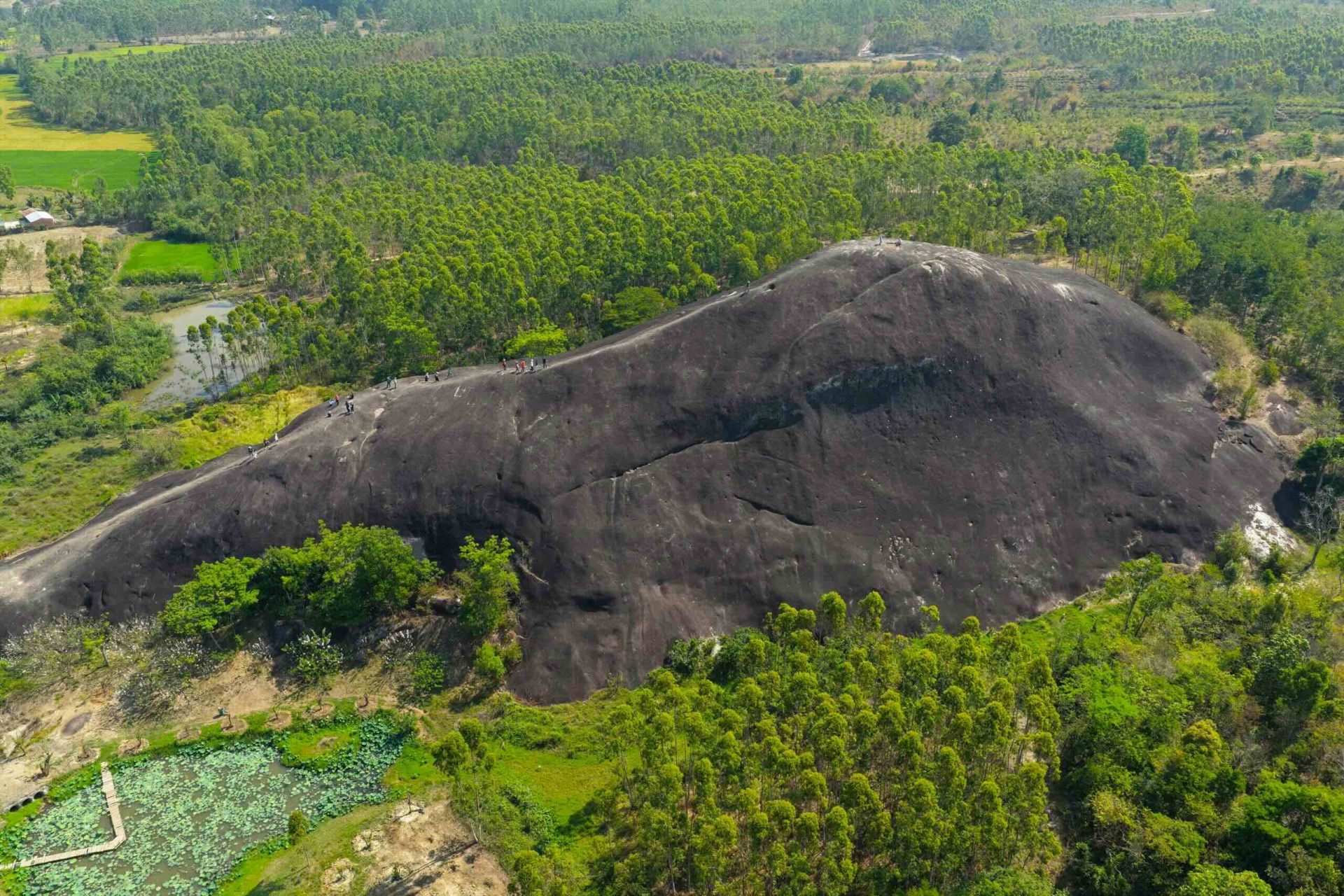
Mother Elephant Rock is a striking natural landmark set amid the vast landscapes of the Central Highlands province of Dak Lak. Rising from a sea of forested hills, the site stands out as a rare geological formation shaped by time and myth.
The attraction lies not only in its unusual form but also in its raw, untouched beauty, which blends seamlessly with the rugged grandeur of the surrounding wilderness. Deeply embedded in local culture, the site is also the subject of enduring folklore, adding a layer of intrigue to any visit.
Visitors encounter two massive rock formations resembling elephants resting in the wild. Locals affectionately call them Mother Elephant Rock and Father Elephant Rock. Though separated by a few kilometers, the pair is widely regarded as inseparable in the local imagination, symbolizing enduring bonds and harmony.
The origins of these formations remain unclear. Generations have passed down stories about their mysterious appearance in ancient times. Some tales even suggest the “stone elephants” once moved closer together, reinforcing their symbolic connection.
In local folklore, Mother Elephant Rock is also associated with love and devotion. Couples visit to make vows or seek lasting relationships, while others come in hopes of finding romance, lending the site a quiet spiritual dimension.
Beyond its cultural significance, the landscape itself is captivating. The solitary granite mass rises prominently from the rolling hills, creating a scene that feels both powerful and serene. From a distance, it resembles a giant elephant reclining against the landscape.
Despite its scale, reaching the summit is easy. A gentle 15-minute climb offers panoramic views of lush forests, with notable landmarks such as Yang Reh Lake and the Chu Yang Sin range, often called the roof of the Central Highlands, visible on the horizon.
Located about 40 kilometers from downtown Buon Ma Thuot Ward along National Highway 27, the rock measures roughly 200 meters in length, has a base circumference of nearly 500 meters, and stands more than 30 meters tall. It is considered one of Vietnam’s largest monolithic granite formations.
The best time to visit is during the dry season, from December to April, when conditions are safer and the trails are easier to navigate. Yet whenever you go, the journey offers more than scenic views. It is a chance to connect with nature, history, and the enduring cultural rhythms of the Central Highlands.