
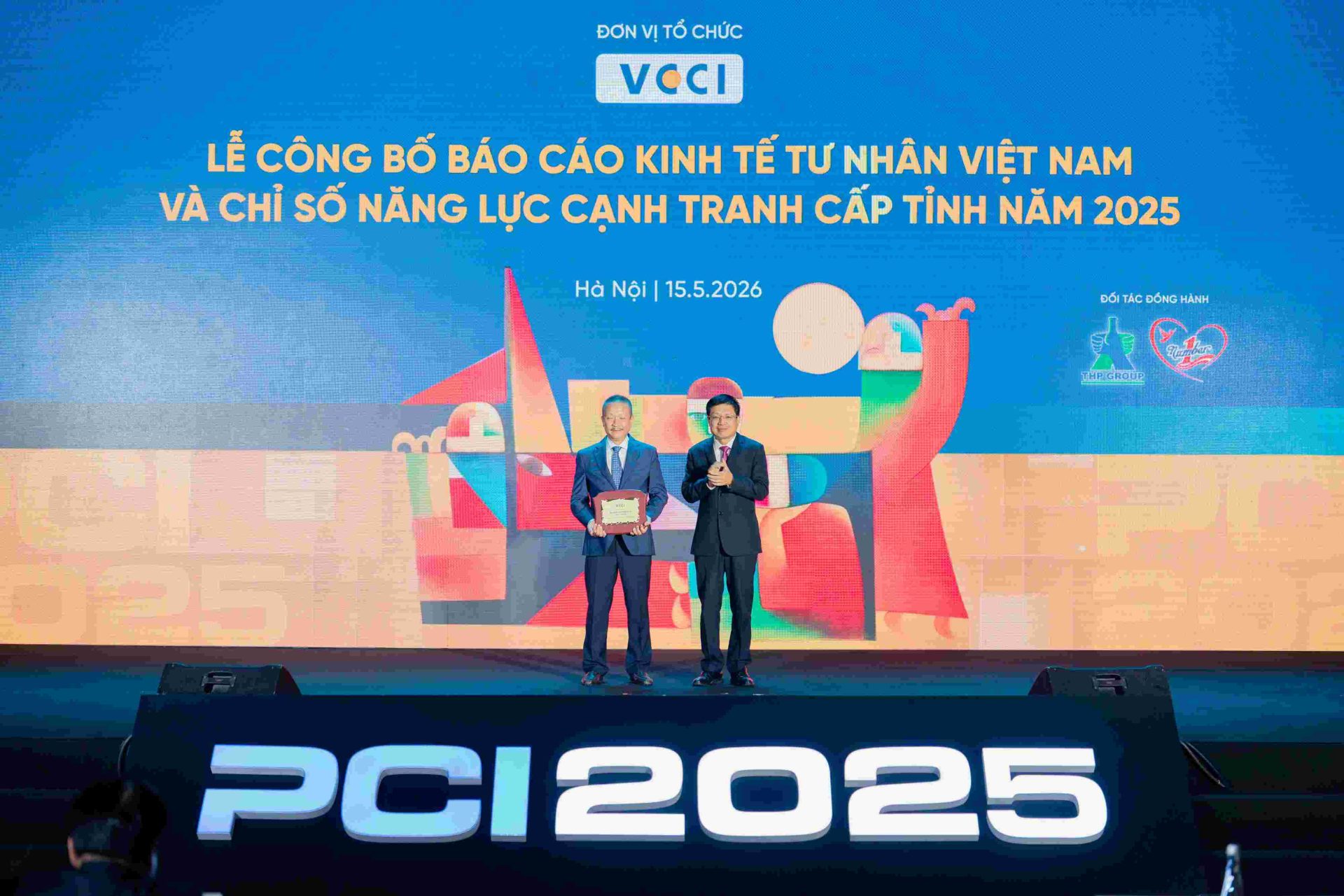
After more than two decades of accompanying reforms in Vietnam’s business and investment climate, PCI 2025 marks a significant evolution by broadening its focus from evaluating local governance quality to evaluating the broader private sector development ecosystem.
A broader assessment of the private sector ecosystem
The Vietnam Chamber of Commerce and Industry (VCCI) on May 15 released the Vietnam Private Economic Report 2025 and the 2025 Provincial Competitiveness Index (PCI 2025) in Hanoi.
According to Assoc. Prof. Dr. Ho Sy Hung, president of VCCI, PCI 2025 introduces major changes in both methodology and approach toward the private sector. For the first time, VCCI has introduced a comprehensive Vietnam Private Sector Economic Report, instead of focusing solely on provincial economic governance quality as in previous years.

Notably, VCCI this year introduced the Business Performance Index (BPI) for the first time to complement PCI with a new perspective. While PCI measures “institutional inputs,” including the quality of governance and the business environment, BPI focuses on “market outputs,” reflecting businesses’ ability to survive, generate profits, and move deeper into value chains.
Based on the survey results, VCCI said the private sector is gradually moving past its difficult period and entering a stronger recovery cycle. However, the report also highlighted major bottlenecks holding back private sector growth. Among them, 60.2% of businesses reported difficulties in finding customers and expanding markets, a sharp increase compared with previous years. Access to capital also remains a major challenge, with 75.5% of firms saying they could not obtain loans without collateral. The report further noted that Vietnamese businesses still lag behind regional peers in innovation capacity.
According to the VCCI president, PCI’s role in the new phase is no longer to fuel a competition in rankings among localities, but to act as a diagnostic tool that helps local governments identify weaknesses and improve policy execution. As a result, VCCI decided not to publish the traditional ranking from 1 to 34 in 2025, instead grouping localities into six categories based on governance quality. According to the results, the five localities rated in the “Good” governance group of PCI 2025 were Danang, Bac Ninh, Haiphong, Phu Tho, and Quang Ninh. For the pilot BPI index, the top three localities were HCMC, Hanoi, and Quang Ninh.
Dau Anh Tuan, vice secretary-general and director of the Legal Department at VCCI, said the private sector currently accounts for 96.6% of all active businesses in Vietnam, with more than one million enterprises, making it the backbone of the economy. However, most businesses remain small in scale and have limited internal capacity. More than 80% employ fewer than 50 workers, while over 70% have charter capital of less than VND10 billion.
According to Dau Anh Tuan, the three biggest challenges facing private businesses today are finding markets and customers, accessing capital due to a lack of collateral, and dealing with a policy environment that remains unstable and difficult to predict.
Vietnamese firms improve business environment
One notable highlight of PCI 2025 is the shifting role of the private sector, from being a “beneficiary” to becoming a “partner” in improving the business environment. For the first time, a wholly Vietnamese company, Tan Hiep Phat, joined PCI as a supporting partner after international sponsors ended their funding, alongside the launch of the Vietnam Private Sector Economic Report. The participation of Tan Hiep Phat carries not only financial significance, but also reflects the growing maturity of Vietnam’s private sector in helping shape the business environment and promote institutional reforms.

“The fact that a Vietnamese private corporation has stepped in to continue sponsoring a national policy research program marks a historically significant shift. It is not only a contribution of resources, but also clear evidence that the Vietnamese business community is taking greater responsibility in shaping the business environment for itself and for future generations of entrepreneurs,” said Ho Sy Hung, president of VCCI.
Nguyen Duy Hung, board member of Tan Hiep Phat Group, said Vietnamese private enterprises are entering a pivotal period with ample growth opportunities. However, he noted that such opportunities will not translate into real outcomes unless the business environment improves, institutional bottlenecks are removed in a timely manner, and businesses themselves actively pursue innovation.