
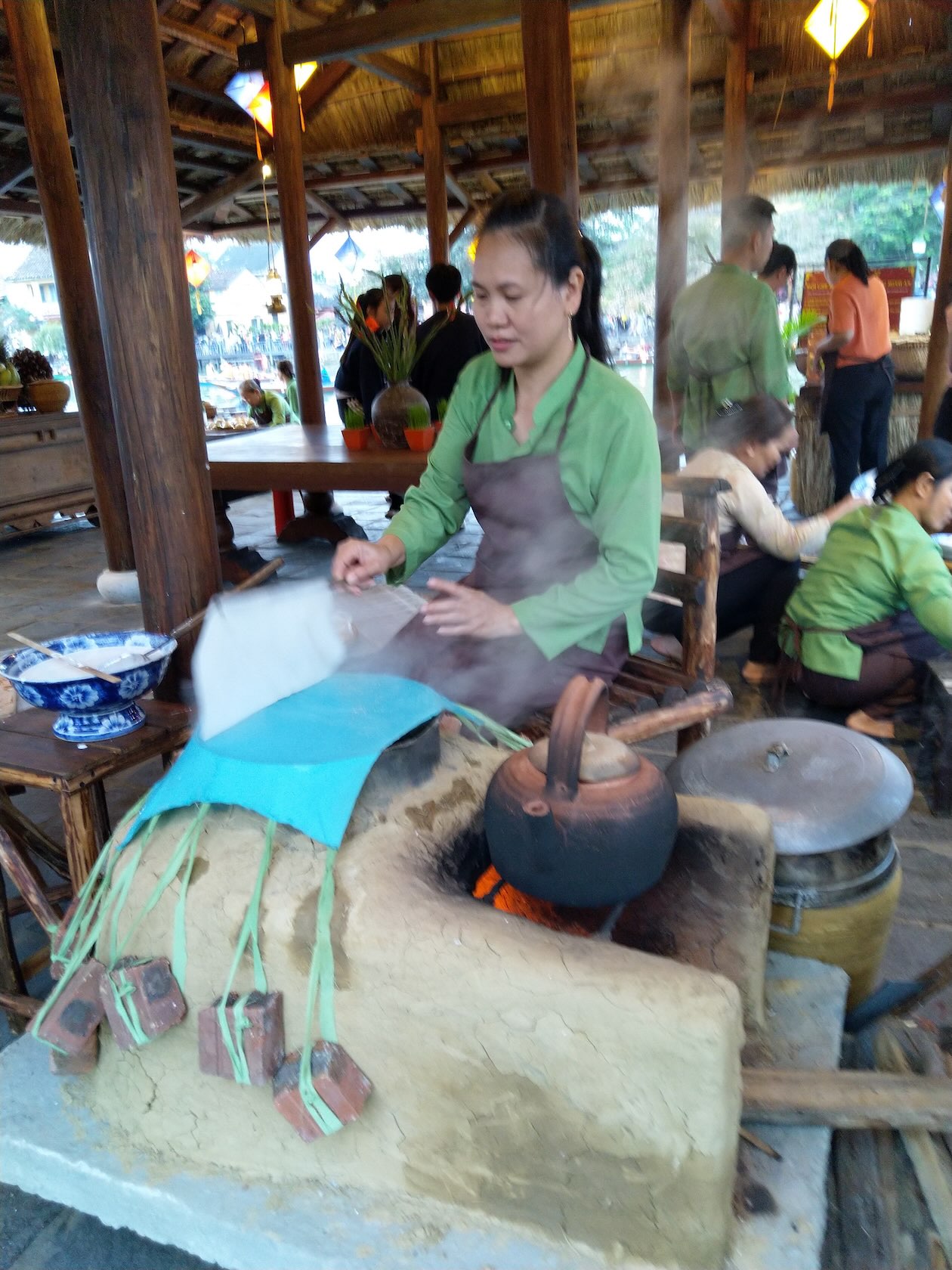
From broken noodle sheets to a symphony of senses along the Hoai River, banh dap reflects the spontaneous creativity and rustic culinary spirit of the Quang people in ancient Hoi An, now part of Danang City.
Hoi An is known not only for its moss-covered tiled roofs and glowing lanterns reflected on the Hoai River, but also for its rustic culinary heritage, where every dish carries a story of its own.
While many foods in the ancient town bear traces of Chinese influence and the cultural blending brought by waves of migration, across the old iron bridge in Cam Nam lies a more indigenous treasure: banh dap. More than a cheap afternoon snack, the dish stands as a vivid testament to the spontaneous creativity of the Quang people, where a simple mishap in the kitchen can give birth to a culinary legacy that endures for decades.
The origins of banh dap begin with a story about farmers’ respect for rice. Locals say banh uot, the soft steamed rice sheet that later became part of banh dap, was born from “failed” Quang noodles. While steaming noodle sheets, cooks occasionally made them too thin or accidentally tore them, leaving them unsuitable for cutting into neat strands.
Unwilling to waste ingredients or labor, they rolled up the soft rice sheets and dipped them into mam cai, a fermented anchovy sauce, for a quick meal. This thriftiness opened the door to a new world of flavor, as the delicate sheets offered a lighter and more refined texture than traditional noodles. Over time, people in Hoi An refined the technique, making the rice sheets smaller so they fit neatly in one’s palm, transforming a makeshift dish into an elegant snack that became popular in the town from the mid-1950s onward.
A marriage of crispness and softness in folk cuisine
Yet Cam Nam’s culinary evolution did not stop there. The pursuit of texture eventually led to the creation of banh dap as it is known today. In the early 1970s, local cooks made a bold culinary pairing by sandwiching a soft steamed rice sheet between two crispy grilled rice crackers.
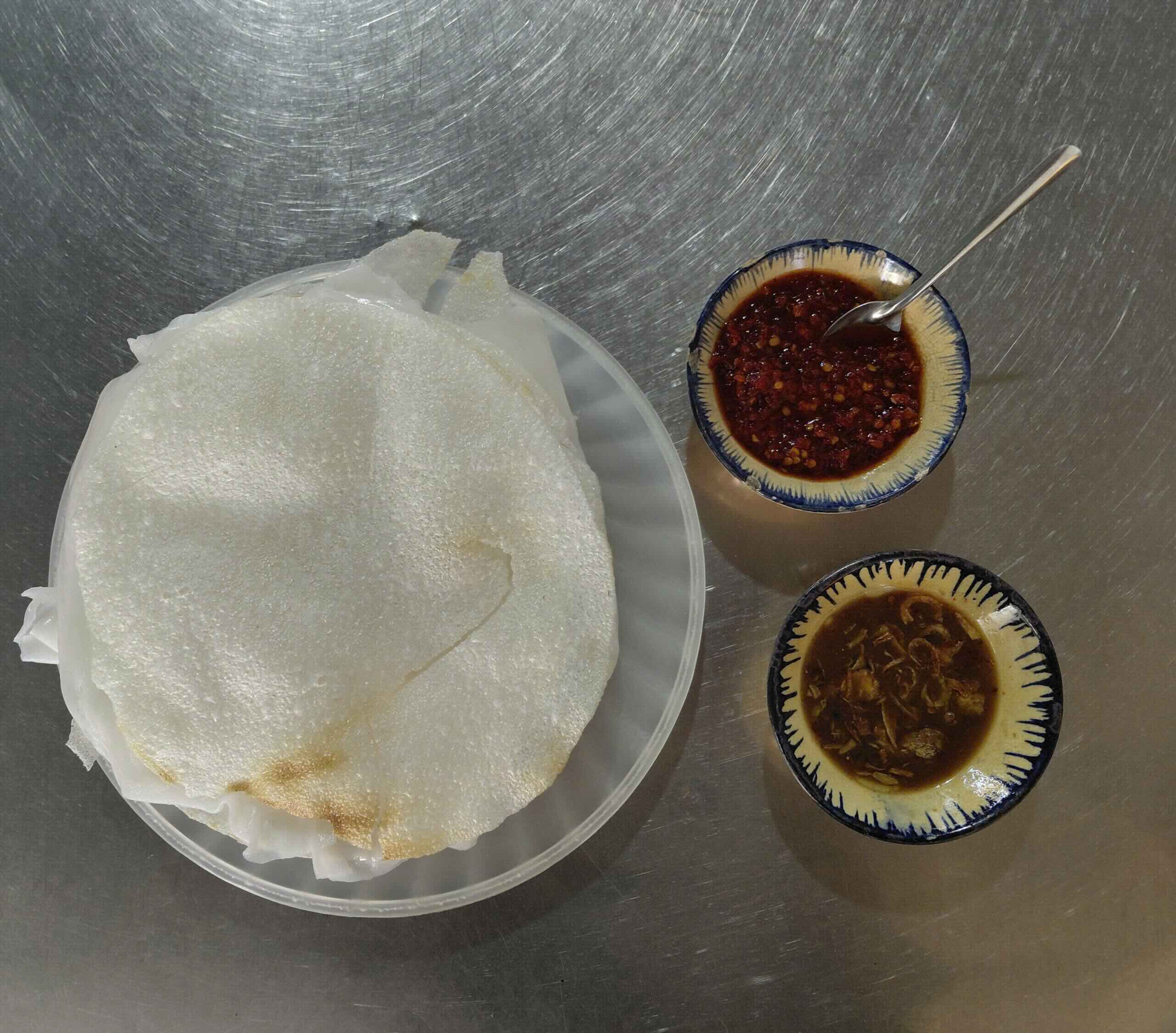
A serving of banh dap is paired with fermented anchovy dipping sauce, whose salty, spicy and rich flavors define the rustic specialty of Hoi An
The name banh dap, literally “smashed cake,” emerged in a straightforward manner that reflected the character of the central Vietnamese people: simple and unpretentious. That very “smash” unintentionally created a perfect culinary structure, where the crunch born of fire and the supple softness born of steam coexist in a single bite.
Eating banh dap is a multisensory journey that few sophisticated dishes can rival. Visually, diners are greeted by golden rice crackers resting on dark bamboo trays, alongside bowls of vivid red mam cai, glistening with peanut oil and fried shallots. The moment hands touch the cracker, the crisp shattering sound signals the beginning of the meal. Touch joins the experience as fingers tear apart each piece, feeling the brittle outer layer yield to the soft interior.
Taste, finally, delivers the climax. The cracker soaked in fermented anchovy sauce brings together the saltiness of the sea, the sweetness of sugar, the sharp heat of garlic and chili, and the richness of peanut oil. It is a symphony in which no ingredient overwhelms another, but instead blends harmoniously into a deeply satisfying whole.
The soul hidden in wood-fired smoke and old bowls of fish sauce
Creating authentic banh dap requires hours of labor beside wood-fired clay stoves. Making rice sheets may appear simple, but in reality it is an art that demands precision and sensitivity. Over a pot of boiling water covered with a cloth, finely ground rice batter is spread evenly by hand. The cook must gauge doneness instinctively, like an artist. A few seconds too early and the batter remains raw; a few seconds too late and the sheet loses its signature elasticity.
Even the rice crackers used for grilling require similar care. If spread unevenly, they burn in some places and remain undercooked in others, ruining the pleasure of eating. Every cracker that leaves the stove carries the sweat of the maker, the soot accumulated on kitchen walls over decades, and the dedication of artisans unwilling to accept carelessness.
For many people, memories of Cam Nam banh dap are inseparable from the tiny eatery called “Ba Ba Gia” (literally “Three Old Ladies”), where time seemed to freeze among rows of brown bamboo racks drying rice crackers in the sun. Despite the name “Three Old Ladies,” the shop actually had four people, including a quiet elderly man whose secret dipping sauce helped build the place’s reputation.
What distinguished one banh dap stall from another was never the rice batter itself, but the bowl of mam cai. At the eatery, the sauce was thick and intensely flavored with anchovies rather than diluted. Yet what visitors remembered most was the distinctly Quang-style hospitality: generous, slightly stern, but oddly affectionate. The owner’s playful scolding whenever customers asked for extra sauce was less irritating than rustic care, a bond between seller and diner that transcended commerce. That warmth somehow made the banh dap taste sweeter, even when the sauce burned with chili and ginger.
Today, Cam Nam has transformed into a bustling tourist destination lined with paved roads and spacious restaurants. Travelers still come seeking the famous banh dap, but perhaps the original flavor of past decades now survives mainly as nostalgia in the minds of older generations.
It is not that today’s cooks are less skillful. Rather, modern life has deprived people of the slowness needed to feel the warmth of wood-fired stoves and the quiet needed to hear the crisp crack of rice crackers breaking in the afternoon breeze beside the river.
Cam Nam’s banh dap remains fundamentally unchanged, still the union of grilled crackers and soft rice sheets. Yet each time diners break apart a piece, they are reminded of elderly figures standing beside soot-darkened brick stoves. It is not merely nostalgia for a dish, but for an entire way of life, a time when creativity was born from hardship and scarcity, then transformed into a cultural value impossible to replace.