
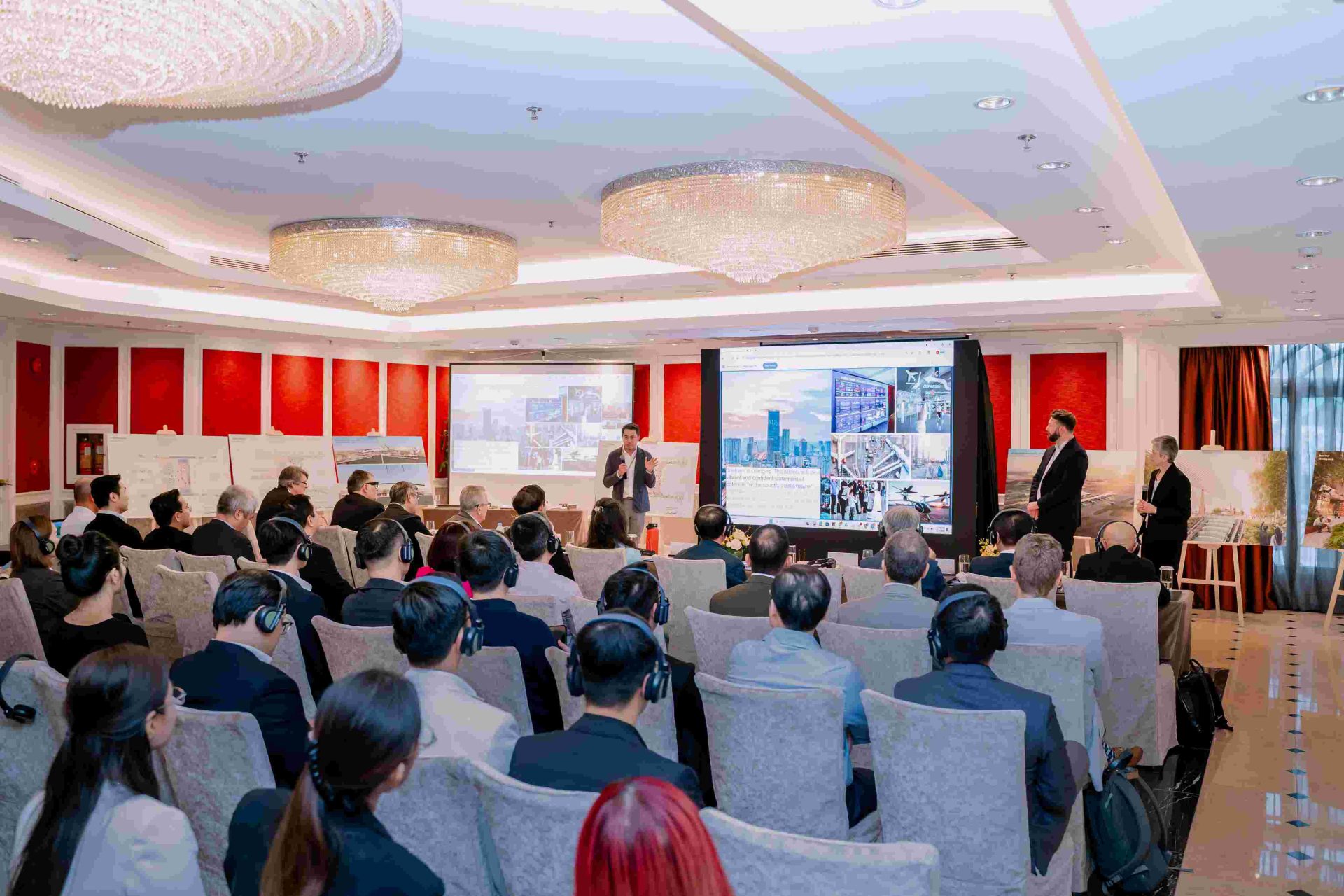
Organized by Masterise Group, the Architectural Design Competition for Gia Binh International Airport Passenger Terminal brings together three of the world’s most renowned architectural firms – Gensler (USA), SOM (USA), and Nikken Sekkei (Japan) – to find the best design solution for Vietnam’s new landmark. The competition represents a key milestone in developing strategic national infrastructure during Vietnam’s rising era.
Creating the northern gateway: A future Asia-Pacific passenger, cargo, and MRO hub
On November 8, 2025, the presentation round of the design competition was held at Sofitel Legend Metropole Hanoi, featuring three major architectural firms: Skidmore, Owings & Merrill LLP (SOM – USA), Nikken Sekkei Ltd. (Japan), and Gensler (USA). These firms are responsible for some of the world’s top Skytrax 5-star airports – notably Incheon (South Korea), Haneda (Japan), and Changi (Singapore) – and possess proven expertise in designing passenger terminals that are functional, sustainable, and reflective of local identity.
The competition was organized as an international design contest to choose the best architectural solution for the Gia Binh International Airport Passenger Terminal. It followed a strict professional process: live presentations, independent evaluations, secret voting, transparent announcement of results, and full adherence to Vietnamese legal regulations as well as international standards in architecture, planning, and construction.
The final presentation round was evaluated by an international Jury Panel composed of leading experts in architecture, planning, aviation, and large-scale infrastructure development, including: Professor Richard De Neufville of the Massachusetts Institute of Technology (MIT), USA; Israeli–Canadian–American architect and urban planner Moshe Safdie of Safdie Architects; Mr. Cristiano Ceccato de Sabata, Director at Zaha Hadid Architects; Mr. Laurence Liauw, Principal Director of SPADA and Adjunct Associate Professor at the Faculty of Architecture at the University of Hong Kong; and Mr. Trevor Carnahoff, Program Director and Regional Market Solutions Lead for Asia Aviation at Jacobs.
Alongside the international experts, representatives from Vietnam’s Ministry of Public Security, Ministry of Construction, the Bac Ninh Department of Construction, and senior leaders of Masterise Group participated, ensuring strict adherence to legal, professional, and international best practices throughout the competition.
A fusion of Vietnamese identity and global standards
In a focused and highly professional environment, all three participating firms presented distinct concepts demonstrating thorough research into the local context and the long-term growth trajectory of Vietnam’s aviation sector.
Pursuing a next-generation “smart – green – sustainable” airport model that supports socioeconomic development, each proposal grounds its architectural concept in Vietnamese culture and landscape, placing people and passenger experience at the center. Design considerations balance feasibility, long-term sustainability, operational efficiency, aesthetics, and the ability to express Vietnamese identity through contemporary airport architecture.
Several notable sustainability ideas were highly valued, including rainwater harvesting and reuse systems, optimized daylighting with skylights, natural nighttime ventilation, low-carbon materials like timber and terracotta, and integrated rooftop solar power systems.
These approaches showcase the dedication and creativity of the three global teams in designing an integrated, future-ready airport – where architecture, engineering, and passenger experience come together within a shared vision of sustainable development.
Jordan Pierce, Senior Associate Principal at Skidmore, Owings & Merrill (SOM), shared: “So our thinking around the design of the new terminal for Gia Binh was that we really wanted to have a design that was inspired by the landscapes of Vietnam, a design that would be resonant with people throughout the entirety of the country because its inspiration would be drawn from the landscapes that make up the beautiful country of Vietnam. We came up with the design of an airport that we’re calling the Terminal of the Water Gardens, where each moment of the passenger journey is marked by a different landscape experience centered around water.”
The Jury Panel evaluated all submissions based on ten comprehensive criteria, including technical feasibility, sustainability, creativity, cultural coherence, functionality, and aesthetic quality. Designs also had to meet international standards for modern airport planning and operation. The selection process was impartial, with independent evaluations and direct professional dialogue, ensuring transparency and quality in every decision.

Laurence Liauw, Principal Director of SPADA (Hong Kong) and Vice Chairman of the Jury, affirmed: “I think this is a very good time for Hanoi to develop a new airport. I think the old airport has been around for a long time, and has served its purpose, its full capacity. So apart from expanding the capacity, I think it represents an opportunity for Hanoi to grow the aviation business. The economy and the population are growing very fast. And Hanoi as a kind of global tourist destination on the world map is increasing its footprint. So I think the new airport will be a very welcome addition to the nation’s expanding tourism and aviation industry”.
Gia Binh International Airport – A new symbol of Vietnam’s global ambition
As the future northern gateway airport and a regional hub for passengers, cargo, and MRO services, Gia Binh International Airport is set to promote growth for Hanoi and the Northern key economic regions, enhancing Vietnam’s competitiveness in logistics, high-tech industries, and large-scale commercial services.
Designed to meet ICAO 4F technical standards and Skytrax 5-Star service benchmarks, the airport is a nationally strategic project of economic, security, defense, and diplomatic importance.
With a projected capacity of 30 million passengers and 1.6 million tonnes of cargo annually by 2030, expanding to 50 million passengers and 2.5 million tonnes of cargo by 2050, the airport aims to stand alongside leading regional hubs such as Changi (Singapore), Incheon (South Korea), and Suvarnabhumi (Thailand).
The Gia Binh International Airport is expected to become Vietnam’s new hub of international connectivity—embodying advanced operational standards, an integrated service ecosystem, and strong global links.

Beyond technical and operational goals, the airport aims to be a symbol of sustainable, smart, green development. From spatial planning and materials selection to operational technologies, the project emphasizes sustainability, energy efficiency, environmental protection, and user experience.
The Architectural Design Competition for the Gia Binh International Airport Passenger Terminal—international in scope and carried out with strict professionalism—reflects the project’s strategic vision and Masterise Group’s strong dedication to applying global expertise and innovation for Vietnam’s next generation of national infrastructure.
| International experts in the Jury Panel:
● Professor, Institute of Engineering and Civil Systems at MIT (Boston) – Jury Chairman ● Mr. Laurence Liauw, Principal Director, SPADA, Adjunct Associate Professor, Faculty of Architecture, The University of Hong Kong – Vice Chairman of the Jury ● Arch. Moshe Safdie, Israeli–Canadian–American architect and urban planner, Safdie Architects ● Mr. Cristiano Ceccato de Sabata, Director, Zaha Hadid Architects ● Mr. Trevor Carnahoff, Program Director & Regional Market Solutions Lead Asia Aviation, Jacobs |