
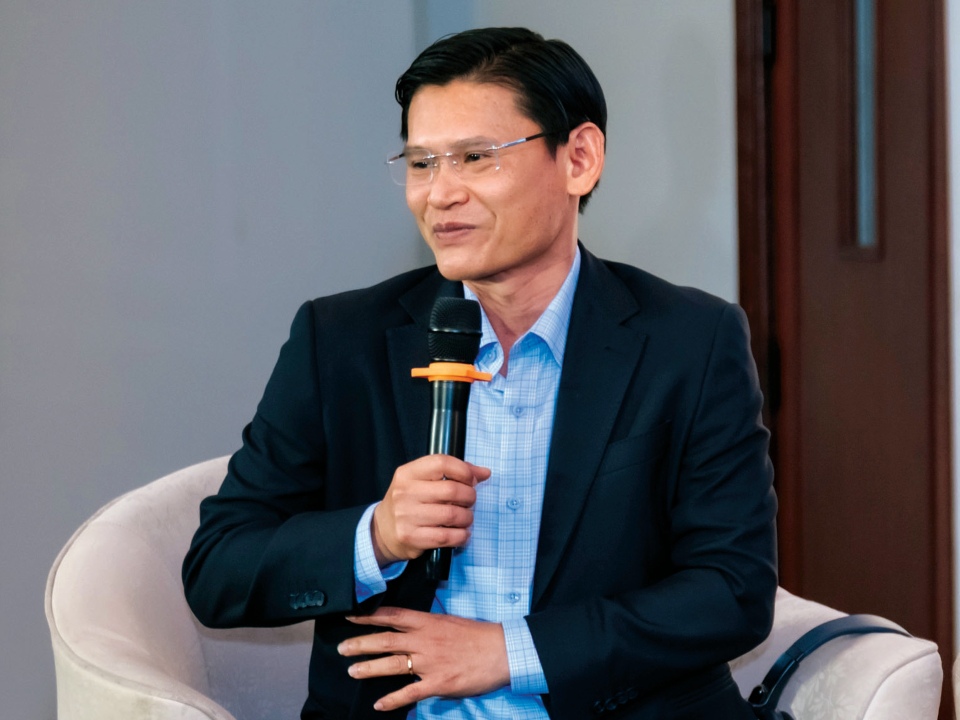
“Every breakthrough in thinking has led to a new growth miracle. Effective implementation of these breakthroughs in Ho Chi Minh City (HCMC) will lay the foundation for establishing and applying this institutional framework nationwide,” said Dr. Huynh Thanh Dien of Nguyen Tat Thanh University in an interview with The Saigon Times regarding the draft Special Urban Law.
Three fundamental principles
The Saigon Times: The latest draft of the Special Urban Law consists of nine chapters and 45 articles, granting approximately 300 powers directly to HCMC’s leadership. How do you expect this legislation to address existing bottlenecks and create new momentum for the city’s development in the coming years?
– Dr. Huynh Thanh Dien: In 2017, the National Assembly adopted Resolution 54/2017/QH14, which piloted special mechanisms and policies for the development of HCMC. Resolution 54 gave the city greater autonomy in areas such as resource management, land administration, talent attraction, and fiscal and budgetary management.
However, the resolution did not fully remove institutional constraints. For example, the city’s ability to mobilize capital through bond issuance and official development assistance (ODA) remained limited by procedural hurdles. Planning overlaps persisted, decentralization was not sufficiently robust, and investment procedures often remained lengthy and cumbersome.
In 2023, the National Assembly continued this effort by adopting Resolution 98/2023/QH15, which introduced additional pilot mechanisms and policies for HCMC. Resolution 98 opened new avenues for the city’s development, including transit-oriented development (TOD), free trade zones, and breakthrough policies designed to attract strategic investors.
Although these two resolutions granted HCMC greater decision-making authority, particularly in planning and capital mobilization, many of those powers have not yet been comprehensively codified into law. As a result, implementation in practice has remained challenging. The city must still operate within existing legal frameworks, including laws, decrees, and circulars. Moreover, its administrative apparatus is still structured largely in the same way as those of localities that neither enjoy special policy mechanisms nor shoulder responsibilities comparable to those of HCMC.
The need for a dedicated legal framework has become even more pressing following the merger of the former HCMC, Binh Duong Province, and Ba Ria–Vung Tau Province. The new HCMC has emerged as a mega-urban region possessing virtually all the conditions necessary for accelerated economic growth.
The city serves as a national hub for finance, commerce, industry, science and technology, innovation, and logistics. Former Binh Duong is a major manufacturing center, while former Ba Ria–Vung Tau is a key energy and logistics hub. Goods produced across the expanded metropolis can now move seamlessly through port infrastructure located throughout the new urban region.
This enlarged HCMC can also strengthen economic linkages with the Mekong Delta provinces to the south and the South Central Coast provinces to the north, supporting regional development and forming a major growth pole for the entire country.
At the same time, Vietnam has set an ambitious goal of entering a new era of national rising characterized by sustained high economic growth. Achieving that objective will require a transformation of the growth model and the creation of new growth drivers through the digital economy, the low-altitude economy, international financial centers, cultural industries, and other emerging sectors. HCMC has been selected as one of the primary locations for piloting these new development models.
Given these expectations, these new responsibilities, and these unique characteristics, the city requires a dedicated law that provides an appropriate institutional framework and legal foundation. The draft Special Urban Law should be designed to meet those requirements.
 HCMC has recently sought public comments on the draft Special Urban Law. In your view, how should the legislation be designed to support the city’s development over the coming decades?
– The draft Special Urban Law should be built around three fundamental principles.
First: What powers should HCMC have? On this point, the latest draft has made significant progress. Under the proposal, the city would be granted approximately 300 specific powers. It would also enjoy greater autonomy in organizing its administrative structure and in issuing legal documents necessary to implement and guide the enforcement of the Special Urban Law.
Importantly, legal instruments promulgated under the authority granted by the Special Urban Law would prevail in cases where multiple legal documents contain conflicting provisions on the same issue.
Second: Can the city effectively exercise those powers? This is an area where the draft law could provide greater clarity. For example, HCMC aims to promote transit-oriented development, and this objective is already reflected in the draft. However, the principles governing how such policies are to be implemented remain less clear. If the intention is for the central government to establish broad policy objectives and oversee outcomes while allowing the city significant room to experiment, learn, innovate, and make its own decisions, then this principle should be explicitly stated from the outset.
Third: Will the city’s administrative apparatus be willing to act? When the rules governing pilot and experimental projects are transparent, public officials will be more willing to take initiative, assume responsibility, and contribute to innovation.
Experimentation inherently involves risks. Without an appropriate framework for projects that have no precedent, officials may hesitate to innovate or pursue unconventional solutions. If no one is willing to take risks, no one will be able to identify the best solutions.
We are gradually moving toward data-driven governance. For that reason, HCMC must take the lead in adopting this new approach to public administration. The city should make policy decisions based on data and be monitored through the same data-driven framework. Such a system would enhance transparency, making misconduct far more difficult while encouraging the entire administrative apparatus to work toward the shared aspiration of transforming HCMC into a leading Asian center for economic development, culture, science, technology, and innovation by 2045.
New thinking, new success
To promote economic development, the draft Special Urban Law outlines detailed directions, including the development of the state sector, the maritime economy, and emerging economic models, while granting HCMC authority over planning and policy formulation. Do you have any additional recommendations?
– I would like to emphasize two additional points. First, many infrastructure projects built in HCMC will be unable to achieve their full potential if they are not connected to neighboring localities. Therefore, there should be a regional infrastructure fund or a common development fund dedicated to projects that support interregional connectivity and growth. The mechanisms for capital mobilization and operational cooperation for such projects should be designed in accordance with their regional nature and importance.
Second, there should be a dedicated support mechanism for businesses that is not constrained by existing legal provisions. The objectives, methods, and scale of support should be determined by HCMC itself, while oversight should be exercised at both the central and municipal levels.
Finally, how do you assess the role of the Special Urban Law in the development of HCMC in particular and Vietnam as a whole in the years ahead?
– Globally, we are witnessing increasingly pronounced geopolitical and economic fragmentation, accompanied by the emergence of new supply chains as well as new financial and logistics services. Vietnam is one of the most open economies in the world. At the same time, it enjoys a stable political environment and is committed to being a reliable and responsible friend and partner to major powers. Transforming our growth model and establishing new economic and financial frameworks will enable Vietnam to integrate more effectively into the global economy, align more closely with advanced economies, and seize opportunities to advance the country’s development.
Another important consideration is that Vietnam has set the goal of achieving high, sustained, and inclusive growth over the coming decades, overcoming the middle-income trap and becoming a high-income country by 2045. To realize this ambition, institutional reform will be essential in laying the foundation for future development. Effective implementation of these institutional breakthroughs in HCMC will, in turn, create the basis for establishing and applying similar institutional frameworks across the country.
On a more specific level, the draft Special Urban Law introduces a number of new development models, including the digital economy, an international financial center, free trade zones, and transit-oriented development (TOD). HCMC will serve as a testing ground for these new ideas. Through implementation, evaluation, and lessons learned, policymakers will be able to identify the most effective approaches.
These policy innovations are not intended solely for HCMC. They can also serve as references for adaptation and application in other localities and eventually nationwide. Previous special mechanisms granted to HCMC, as well as the forthcoming Special Urban Law, are ultimately designed with this broader national objective in mind.







