
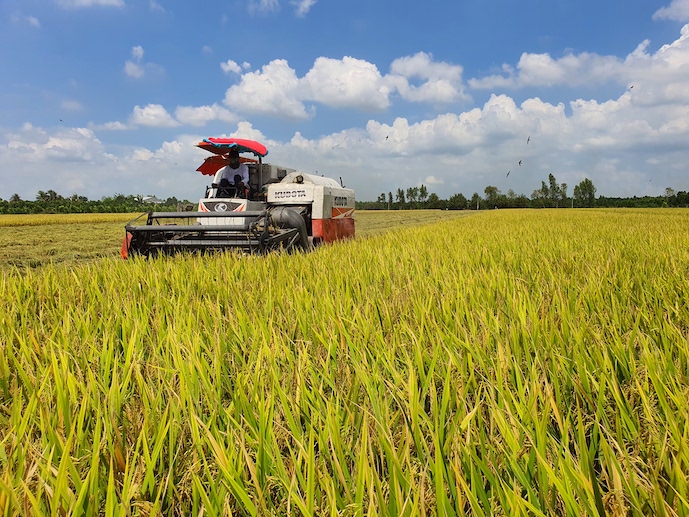
CAN THO – Vietnam’s agricultural sector remains heavily dependent on imported machinery, particularly from China, Japan, and Thailand, despite the country’s position as a major agricultural producer.
Speaking at a seminar on digitalizing agricultural mechanization held in Can Tho City on May 13, Ho Phi Tuan, head of the Electromechanics Division under the Department of Cooperatives and Rural Development at the Ministry of Agriculture and Environment, said domestic manufacturing capacity remains limited.
Vietnam currently has more than 600,000 machines and pieces of equipment used in agricultural production. However, local manufacturers can meet less than 30% of demand, while more than 70% of machinery is imported, mainly from China, Japan and Thailand.
In the Mekong Delta, mechanization has been widely adopted in land preparation, harvesting, and irrigation for rice farming. These stages have helped reduce labor costs and improve productivity.
However, mechanization remains weak in seeding, crop care, storage, and by-product processing. Tuan said the rice sector has mainly mechanized “the beginning and the end” of the production chain, while sowing and field management continue to lag behind.
The issue is considered one of the main bottlenecks affecting the implementation of the Government’s one-million-hectare high-quality, low-emission rice growing project in the Mekong Delta.
Truong Huu Tri, director of Go Gon Cooperative in Tay Ninh Province, said row seeding and cluster seeding methods have produced positive results, particularly in improving yields.
According to Tri, rice fields using these methods achieved yields of around nine tons per hectare, compared to eight tons per hectare under conventional broadcasting methods.
Still, he said mechanized sowing equipment has yet to meet farmers’ actual needs. Access to financing for machinery investment also remains difficult.
Tri said his cooperative had signed a financing agreement with a bank based on its business plan. However, the bank required the cooperative to satisfy nine groups of conditions before disbursement, including legal status, project feasibility, matching capital, use of funds, financial performance, green production standards, supply chain linkages, and land-use certificates as collateral.
“This is very difficult for cooperatives and farmers,” Tri said, adding that more flexible policies and stronger State support are needed to unlock investment capital for agricultural mechanization.
Dao Thi Nhu He, director of Saigon Kim Hong Trading Service Company, said pilot models under the one-million-hectare rice project showed that cluster seeding combined with fertilizer placement delivered clear efficiency gains.
However, adoption has remained slow as many farmers are still reluctant to invest in mechanized production systems.
She said local authorities should introduce support mechanisms to help farmers and cooperatives invest in machinery and equipment, especially for sowing operations, which are considered the weakest link in Vietnam’s rice production chain.